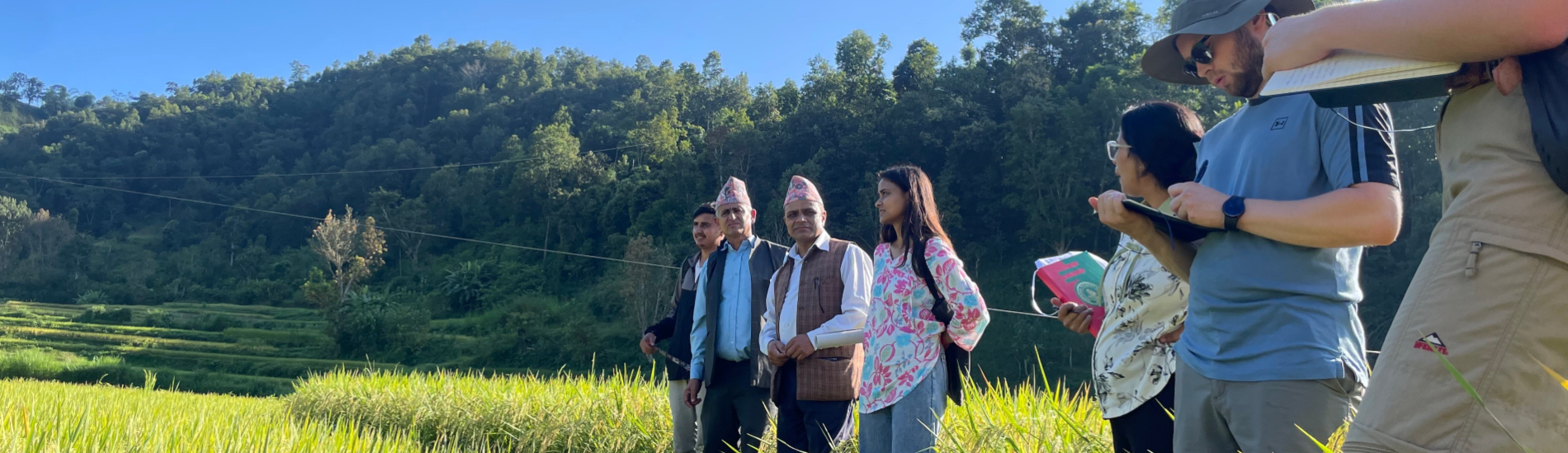
In October, a team of FutureWater, Practica and Climate Resilience Research Centre visited Syangja district in Gandaki province, Nepal, for the ‘Smart Sprayer’ project, a feasibility study funded by the Partners for Water scheme. The project aims to increase water and food security in Nepal by testing and deploying novel smart irrigation technology.
In Syangja district, situated in the mid-hills of Nepal, smallholder farmers rely on springs for irrigation in the dry season (Nov – Mar). Spring discharge is low this time of the year and further reduction can be expected in the face of climate change. Traditional irrigation systems either require high water pressures or have low water use efficiencies. As a result, food insecurity persists while farmers fail to realize their full income potential. this applies not only to the district at hand since Nepal is a net importer of food.
The project is researching the feasibility of the ‘Smart Sprayer’, a system that combines hardware and software to help farmers grow food even under water scarce conditions. It has two components:
- The hardware: a lightweight pivot irrigation system, 12m in diameter, which can operate at pressures as low as 2 m of hydraulic head – far lower than traditional systems. The low pressure and high efficiency allow the system to work under water-scarce conditions.
- Software: our digital irrigation advisory tool Croptimal that uses WAPOR evapotranspiration data, crop specs, and growth stage info to calculate crop water demand. We condense all these datasets and calculations into a single practical SMS message, advising farmers number of minutes to irrigate, saving water while ensuring optimal yields.


By enabling efficient irrigation under water-scarce conditions, farmers can increase crop production for the local market. This is expected to improve both food security, farmer livelihoods, and reduce vulnerability to climate change.
Some highlights of the trip were: researching water security challenges with a selection of 10 local farmers; discussing the technology to the municipalities of Putalibazar and Bheerkot; testing the sprayer and installing a weather station for ground truthing.
The project is a one-year feasibility study, requiring the consortium to move fast. The next steps are the transplanting of seedlings (cauliflower and cabbage); setting up farmer-managed irrigation with the Sprayer guided by SMS advisories; monitoring operations and crop performance by WUR intern Maaike de Wit; as well as developing farmer and supplier-level business cases. The ultimate goal of the project is to assess if the ‘Smart Sprayer’ is technically and financially feasible and can have a positive impact on the lives of smallholder farmers in Nepal.