
Within 3POLE4FOOD, FutureWater contributes to the assessment of long-term climate change impacts on water availability and crop production in major Asian river basins. The project combines  mountain hydrology modelling with downstream hydrology and crop production modelling to better understand how changes in snow, glacier melt, rainfall and temperature affect irrigation water supply and agricultural production.

FutureWater leads key technical activities related to climate forcing, bias-correction of meteorological dataset and the generation of climate change scenarios. Together with Hydrominds and Wageningen University we perform glacio-hydrological modelling and the analysis of upstream–downstream water linkages. Using the SPHY model, historical and future streamflow from mountain areas, including the contributions from rainfall, snowmelt and glacier melt are simulated. These outputs are coupled with the LPJmL model to assess downstream water availability, irrigation demand, crop yields and crop water productivity under future climate and socio-economic scenarios.

The project provides a scientific basis for identifying at-risk areas and understanding where agricultural systems may become more vulnerable to changes in mountain water supply. By linking climate, hydrology and food production, 3POLE4FOOD supports evidence-based planning for resilient river basins and sustainable food systems in Asia.
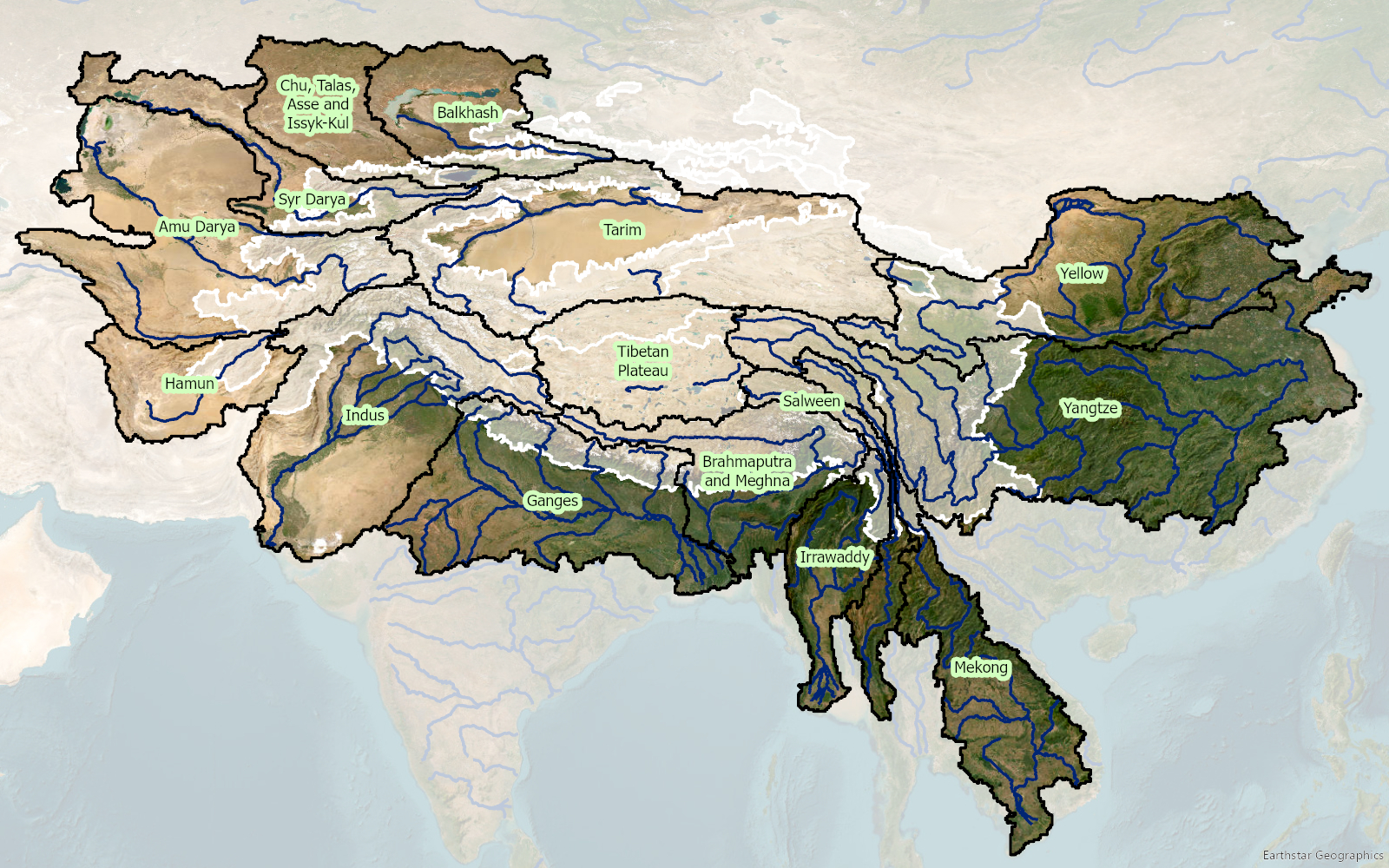

River basins originating in High Mountain Asia included in the 3POLE4FOOD project. The white polygon indicates the high mountain parts.

Home to the world’s largest semi-natural walnut-fruit forest, the Arslanbob region in Jalal-Abad province has lost roughly half of its forest cover between 1990 and 2018, with forest extent declining from over 100,000 hectares to around 45,000 hectares. Unsustainable pasture use, overgrazing, forest encroachment, and weak enforcement of land-use regulations have constrained natural regeneration. At the same time, climate change is intensifying ecological stress: temperatures in the Kyrgyz Republic have risen by 1.3°C over the past four decades and are projected to climb further, bringing late frosts that affect walnut yields, drying springs, declining snowpack and groundwater recharge, more frequent pest outbreaks and wildfires, and heightened landslide and erosion hazards. Beyond their economic value, these forests regulate water flows to the downstream Ferghana valley, stabilize slopes, and reduce the risk of floods, landslides, and mudflows.

With support from ADB, the CARE project promotes Nature-based Solutions including reforestation, sustainable pasture management, adaptive agroforestry, and integrated forest-pasture governance, supported by digital monitoring and community engagement. To ensure these interventions are designed to withstand future climate conditions, FutureWater conducted a detailed climate risk and adaptation assessment which included:

  1. An analysis of historic climate and CMIP6-based future climate projections for Jalal-Abad province, including trends in temperature, precipitation, seasonality, and climate extremes under SSP2-4.5 and SSP5-8.5
  2. A climate risk assessment combining hazard, exposure, and vulnerability information to evaluate the project’s risk from floods, droughts, heatwaves, wildfires, landslides, and mudflows
  3. A set of targeted adaptation options, such as diversification of species composition, climate-informed regeneration zoning, soil organic carbon enhancement, water harvesting, and dynamic grazing plans
  4. An estimate of the greenhouse gas mitigation potential of forest regeneration and improved pastureland management.

The Kyrgyz Republic’s power system remains highly dependent on hydropower, which accounts for around 87% of total electricity generation. Aging infrastructure and recurring seasonal generation variability expose the system to hydrological shocks and climate-related risks. Because hydropower output depends critically on water availability, the country increasingly faces mismatches between seasonal water inflows and electricity demand, particularly in winter when inflows are low but heating-related demand peaks. In recent years this has driven a growing dependence on electricity imports from neighbouring countries, highlighting a structural vulnerability in the country’s energy security.

With support from the Asian Development Bank, the Government of the Kyrgyz Republic aims to address these constraints through a low-regrets diversification option that leverages existing reservoirs and electricity evacuation infrastructure, avoiding land acquisition and permitting bottlenecks. The FPV plant, located about 10 kilometres northeast of Bishkek, builds on a successful 100 kilowatt ADB pilot at the same site and is expected to generate approximately 20 GWh annually. The project has three major outputs:

  1. Constructing a climate-resilient floating solar photovoltaic plant with standardized technical and performance requirements documented for replication,
  2. Completing grid interconnection and substation upgrades with grid-code compliance and interconnection requirements documented to inform future FPV development, and
  3. Delivering regional knowledge sharing on floating solar PV, including knowledge exchange events and a regional knowledge product disseminated across the Kyrgyz Republic, Tajikistan, and Azerbaijan.

To assess the exposure and vulnerabilities of project components to potential climate risks, a detailed Climate and Disaster Risk and Adaptation (CDRA) assessment will be conducted, drawing on downscaled climate projections, relevant hazard data, and local information. The insights gained will enable ADB to embed effective adaptation and mitigation measures in the project design, strengthen the resilience of the hydropower-linked supply system, and ensure climate-resilient development across the water–energy nexus.

The Central Asia Regional Economic Cooperation (CAREC) program incorporated agriculture and water as a new pillar in 2017 under its CAREC 2030 strategy to promote cooperation on water scarcity, productivity, and regional water management. A scoping study, to which FutureWater provided technical inputs, and supported by the Asian Development Bank (ADB), led to the development of a framework for the CAREC Water Pillar, which received regional endorsement during consultations. A dedicated Water Pillar Working Group consisting of representatives from the five Central Asian countries prioritized three projects for pre-feasibility studies.

For these pre-feasibility studies, FutureWater assesses climate risks and impacts on water resources on the various project locations. The projects include two transboundary infrastructure projects linked to the Bakhri Tojik reservoir, and should provide benefits to Uzbekistan, Tajikistan, Kyrgyz Republic and Kazakhstan. A third project aims at deploying a regional automated hydrometeorological monitoring system.


The project prepares robust climate mitigation and adaptation pipelines aligned with the Paris Agreement and responsive to DMCs climate change priorities. The TA will support interventions on departmental, sectoral and country levels with key activities including development of a regional strategy, upstream climate assessments, climate pipeline development, government dialogues and capacity building. As part of this project, FutureWater conducts a regional climate risk assessment for ten countries. This includes an assessment of baseline and future climate hazards, exposure and vulnerability and addressing sectoral impacts and adaptation options for a wide range of sectors. In addition country profiles summarizing climate risks for the ten countries are generated. The reginal climate risk assessment feeds into the climate strategy.

Over the last decades, efficient water resources management has been an important element of EU’s water policies, a topic that is addressed with renewed attention in the revised 2021 EU Adaptation Strategy, which lists the need for a knowledge-based approach towards water-saving technologies and instruments such as efficient water resources allocation. The IPCC special report on oceans and the cryosphere in a changing climate (2019) highlights the combination of water governance and climate risks as potential reasons for tension over scarce water resources within and across borders, notably competing demands between hydropower and irrigation, in transboundary glacier- and snow-fed river basins in Central Asia.

WE-ACT’s innovative approach consists of two complementary innovation actions: the first is the development of a data chain for a reliable water information system, which in turn enables the second, namely design and roll-out of a decision support system for water allocation. The data chain for the reliable water information system consists of real-time in-situ hydrometeorological and glaciological monitoring technology, modelling of the water system (including water supply and demand modelling and water footprint assessments) and glacier mass balance, data warehouse technology and machine learning. The roll-out of the DSS for climate-risk informed water allocation consists of stakeholder and institutional analyses, water valuation methods, the setup of the water information system to allow for a user-friendly interface, development of water allocation use cases, and feedback on water use through national policy dialogues.

The work of FutureWater within the WE-ACT study will focus on estimating the water demand and water footprints of the different users and activities within the Syr Darya river basin. Therefore, the effects of water allocation on water footprints, unmet water demand and environmental flow violations will be evaluated using a set of hydrological models such as SPHY and Water Allocation models (WEAP). This will be done for both the status quo and future scenarios.

For more information you can visit the WE-ACT project website.

Recently, the Central Asia Regional Economic Cooperation (CAREC) Program introduced agriculture and water as a new cluster in its strategic framework. Recognizing the complexities of the water sector and the existing landscape of cooperation activities, the strategic framework proposes a complementary approach that uses the strengths of CAREC to further promote dialogue on water issues. A scoping study was commissioned, supported by the Asian Development Bank (ADB), to develop a framework for the Water Pillar for further consideration by the governing bodies of CAREC. It was agreed that the initial focus of the Water Pillar should be on the five Central Asian states with consideration given to expanding to other CAREC member countries over time.

The objective of the study is to develop the scope of a Water Pillar Framework that includes a roadmap of national development interventions for each of the five Central Asian Republics that responds to the prevailing challenges and opportunities in water resources management.

The framework will be derived from three specific outputs:

  • Output 1: Projection of future availability and demand for water resources for the Central Asia region up to 2050 including implications of climate change.
  • Output 2: Identification of future water resources development and management opportunities in the form of a sector specific framework for water resources infrastructure taking into consideration sustainability issues through a comparative assessment of cost recovery mechanisms and operation and maintenance (O&M) practices.
  • Output 3: Preparation of a framework for policy and institutional strengthening that addresses common themes and issues related to national water resources legislation and the capacity and knowledge development needs of water resources agencies with an emphasis on economic aspects and sustainable financing.

For this work, FutureWater provides key inputs on the climate change and water resources aspects, including desk review, stakeholder consultations across the five regions and across all sectors, and analysis of climate change risks and identification of adaptation options that have a regional dimension and can be taken up through regional or bilateral cooperation. Following the scoping study, FutureWater supports in the identification of priority activities based on an extensive consultative process in the region, with emphasis on climate resilience. Also it supports the identification of potential water pillar development partners and financing opportunities, including steps needed to qualify for climate finance

Kyrgyzstan is a highly mountainous country with relatively high precipitation in upslope areas. This, alongside the development and deforestation of basins to make way for industry and agriculture means that land has become increasingly degraded and vulnerable to erosion over recent decades. Reservoirs in the country provide access to water resources and energy in the form of hydropower, but are highly susceptible to sedimentation by eroded material. Sedimentation necessitates increased maintenance costs, reduces storage capacity and disrupts hydropower generation. It is therefore proposed that landscape scale restoration measures (e.g. tree planting) can provide key ecosystem services by reducing vulnerability to erosion and decreasing sediment delivery to reservoirs. This project therefore identifies highly degraded areas of land and determines in which of these interventions are possible. With the outcomes of this study, the World Bank – in partnership with the government of Kyrgyzstan – can prioritise investments in terms of landscape restoration efforts. The outcomes of this project will therefore reduce maintenance costs for reservoirs and contribute to the afforestation and restoration of multiple areas in Kyrgyzstan.

The SREB is part of the Belt and Road Initiative, being a development strategy that focuses on connectivity and cooperation between Eurasian countries. Essentially, the SREB includes countries situated on the original Silk Road through Central Asia, West Asia, the Middle East, and Europe. The initiative calls for the integration of the region into a cohesive economic area through building infrastructure, increasing cultural exchanges, and broadening trade. A major part of the SREB traverses Asia’s high-altitude areas, also referred to as the Third Pole or the Asian Water Tower. In the light of the planned development for the SREB traversing the Third Pole and its immediate surroundings, the “Pan-Third Pole Environment study for a Green Silk Road (Pan-TPE)” program will be implemented.

The project will assess the state and fate of water resources in the region under following research themes:

1. Observed and projected Pan-TPE climate change
2. Impacts on the present and future Water Tower of Asia
3. The Green Silk Road and changes in water demand
4. Adaptation for green development