Timor-Leste’s power system remains highly dependent on imported diesel, with two diesel-fired plants supplying the overwhelming majority of generation. Heavy reliance on imported fossil fuels exposes the system to fuel-price and supply shocks and has left the state utility, Electricidade de Timor-Leste (EDTL), unable to recover the cost of supply, recovering only around 27% of its expenditure in 2023. Because the system is so narrowly based, the country faces persistent energy insecurity and high costs, with little of the distributed renewable generation that could reduce technical losses and strengthen the reliability of local supply. In recent years this has reinforced a structural vulnerability in the country’s energy security, underlining the need to diversify the generation mix and expand cleaner, more affordable sources of power.

With support from the Asian Development Bank, the Government of Timor-Leste aims to address these constraints by rehabilitating an existing renewable asset, leveraging the established alignment, intakes, and grid connection of the Gariuai mini-hydropower plant and avoiding land acquisition and permitting bottlenecks. The 326 kW spring-fed, run-of-river plant, located near Baucau on the north coast, was the country’s first hydroelectric scheme and is expected, once restored, to supply renewable electricity to the national grid and displace diesel-fired generation. The project has three major outputs:

  1. Rehabilitating and recommissioning a climate-resilient mini-hydropower plant and its transmission interconnection, with standardized technical and performance requirements documented for replication,
  2. Strengthening the institutional capacity of EDTL to manage, operate, and maintain climate-resilient distributed renewable generation, and
  3. Updating the national Hydropower Master Plan to reassess project feasibility and guide future renewable energy development across Timor-Leste.

To assess the exposure and vulnerabilities of project components to potential climate risks, a detailed Climate and Disaster Risk and Adaptation (CDRA) assessment was conducted, drawing on the latest climate projections, relevant hazard data, and local information. The insights gained will enable ADB to embed effective adaptation and mitigation measures in the project design, strengthen the resilience of the distributed renewable supply system, and ensure climate-resilient development across the water–energy nexus.

Home to the world’s largest semi-natural walnut-fruit forest, the Arslanbob region in Jalal-Abad province has lost roughly half of its forest cover between 1990 and 2018, with forest extent declining from over 100,000 hectares to around 45,000 hectares. Unsustainable pasture use, overgrazing, forest encroachment, and weak enforcement of land-use regulations have constrained natural regeneration. At the same time, climate change is intensifying ecological stress: temperatures in the Kyrgyz Republic have risen by 1.3°C over the past four decades and are projected to climb further, bringing late frosts that affect walnut yields, drying springs, declining snowpack and groundwater recharge, more frequent pest outbreaks and wildfires, and heightened landslide and erosion hazards. Beyond their economic value, these forests regulate water flows to the downstream Ferghana valley, stabilize slopes, and reduce the risk of floods, landslides, and mudflows.

With support from ADB, the CARE project promotes Nature-based Solutions including reforestation, sustainable pasture management, adaptive agroforestry, and integrated forest-pasture governance, supported by digital monitoring and community engagement. To ensure these interventions are designed to withstand future climate conditions, FutureWater conducted a detailed climate risk and adaptation assessment which included:

  1. An analysis of historic climate and CMIP6-based future climate projections for Jalal-Abad province, including trends in temperature, precipitation, seasonality, and climate extremes under SSP2-4.5 and SSP5-8.5
  2. A climate risk assessment combining hazard, exposure, and vulnerability information to evaluate the project’s risk from floods, droughts, heatwaves, wildfires, landslides, and mudflows
  3. A set of targeted adaptation options, such as diversification of species composition, climate-informed regeneration zoning, soil organic carbon enhancement, water harvesting, and dynamic grazing plans
  4. An estimate of the greenhouse gas mitigation potential of forest regeneration and improved pastureland management.

The Kyrgyz Republic’s power system remains highly dependent on hydropower, which accounts for around 87% of total electricity generation. Aging infrastructure and recurring seasonal generation variability expose the system to hydrological shocks and climate-related risks. Because hydropower output depends critically on water availability, the country increasingly faces mismatches between seasonal water inflows and electricity demand, particularly in winter when inflows are low but heating-related demand peaks. In recent years this has driven a growing dependence on electricity imports from neighbouring countries, highlighting a structural vulnerability in the country’s energy security.

With support from the Asian Development Bank, the Government of the Kyrgyz Republic aims to address these constraints through a low-regrets diversification option that leverages existing reservoirs and electricity evacuation infrastructure, avoiding land acquisition and permitting bottlenecks. The FPV plant, located about 10 kilometres northeast of Bishkek, builds on a successful 100 kilowatt ADB pilot at the same site and is expected to generate approximately 20 GWh annually. The project has three major outputs:

  1. Constructing a climate-resilient floating solar photovoltaic plant with standardized technical and performance requirements documented for replication,
  2. Completing grid interconnection and substation upgrades with grid-code compliance and interconnection requirements documented to inform future FPV development, and
  3. Delivering regional knowledge sharing on floating solar PV, including knowledge exchange events and a regional knowledge product disseminated across the Kyrgyz Republic, Tajikistan, and Azerbaijan.

To assess the exposure and vulnerabilities of project components to potential climate risks, a detailed Climate and Disaster Risk and Adaptation (CDRA) assessment will be conducted, drawing on downscaled climate projections, relevant hazard data, and local information. The insights gained will enable ADB to embed effective adaptation and mitigation measures in the project design, strengthen the resilience of the hydropower-linked supply system, and ensure climate-resilient development across the water–energy nexus.

Yemen is one of the most water-scarce and food-insecure countries in the world, where decades of over-abstraction, fragile institutions, and a changing climate have pushed many river basins beyond sustainable limits. With limited resources and competing needs across domestic supply, agriculture and industry, the Government of Yemen and the World Bank need a transparent, evidence-based way to decide where to invest first. In a data-scarce, conflict-affected setting, no single dataset offers a basin-by-basin picture of water availability, demand and climate risk.

This assignment supports the Government of Yemen and the World Bank in identifying and ranking the country’s 42 water basins and sub-basins for future investment. Delivered by Acacia Water and FutureWater as partners, the work integrates socio-economic, hydrological and remote-sensing data; delineates and characterises the basins; assesses water availability and water balances; analyses climate vulnerability; and brings everything together in a multi-criteria decision analysis (MCDA) framework, with GIS outputs, maps and investment recommendations. Crucially, this data-driven analysis is complemented by stakeholder meetings that capture local and strategic priorities known to policymakers but not visible in the available datasets, ensuring the prioritisation reflects realities on the ground.

FutureWater leads the water demand analysis and climate change impact assessment. We estimate seasonal and annual demand for each basin across the domestic, agricultural and industrial sectors, combining population and per-capita use with irrigated-area and crop water requirements, and develop future demand scenarios. In parallel, we screen each basin for climate risk using the IPCC hazard, exposure and vulnerability framework, drawing on World Bank climate projections for a historical baseline and a 2050 horizon.

These results, together with the insights from stakeholder engagement, feed directly into the basin prioritisation. The outcome gives Yemeni water-sector counterparts and the World Bank a shared basis for ranking basins, defending investment choices.

The project delivers a complete, decision-ready climate-hazard reference for each of Georgia’s ten provinces (the nine mkhare plus the Adjara Autonomous Republic). Specifically, it (i) compiles a consistent climate-trend signal across eight indicators per province under the CMIP6 high-emissions scenario, (ii) translates gridded hazard datasets and global hazard rating databases into a comparable Low–Severe severity scale for six hazards per province across three time horizons (current, 2050, 2090), and (iii) packages these into A4 poster-style profiles ready for inclusion in ADB programme reporting and provincial design workshops.

FutureWater built a reproducible pipeline that brings together three layers of evidence: long-term climate projections, gridded hazard data, and current-day hazard ratings supplemented by Georgia-tuned sea-level rise for the coastal provinces. A hybrid severity strategy selects the most defensible source per hazard, using gridded data where available and expert-calibrated uplift rules on future climate indicators where not. The output for each province is a single one-page profile combining maps, indicator trend charts, and hazard matrices across three time horizons.

With these profiles, ADB and the Government of Georgia’s water-sector counterparts will be able to prioritize settlement-level climate adaptation measures across all ten provinces against a shared, citable evidence base, defend infrastructure-design choices against a transparent severity rating, and re-run the pipeline as updated climate projections and improved gridded hazard layers become available. The same approach can be reused as a template for settlement-level climate screening elsewhere in ADB’s regional water portfolio.

ADB is committed to supporting its developing member countries in scaling up climate action. As part of this commitment, ADB is implementing TA 10098-REG: Bridging the Gap between Climate Adaptation Planning and Financing, also known as the Climate Adaptation Investment Planning (CAIP) TA. The CAIP TA aims to enhance the capacity of developing member countries (DMCs), to identify climate adaptation investment priorities to catalyze financing for adaptation and resilience. The TA delivers three outputs: (i) climate adaptation investment plans developed; (ii) appraisal of climate adaptation projects improved; and (iii) regional knowledge on climate adaptation investment planning strengthened.

The CAIP TA applies a five-step process for climate adaptation investment planning: (i) reviewing country and sector context, including national development plans and strategies, climate policies including the National Adaptation Plan (NAP), Nationally Determined Contribution (NDC), or equivalent adaptation plans; (ii) undertaking more granular climate diagnostic for selected national adaptation priorities; (iii) prioritizing adaptation investments; (iv) linking with public financial management systems; and (v) identifying appropriate financing opportunities.  The CAIP TA brings together different relevant ministries, especially the finance and planning ministry, the respective sector ministry, and the environment ministry. In addition, the implementation process closely collaborates with relevant development partners active in the adaptation space in the country, the private sector, and civil society organizations.

FutureWater was engaged by ADB to develop the climate adaptation investment plans and underlying Climate Risk and Adaptation assessments (CRAs) for selected river basins in Lao PDR and Timor-Leste. Both the CRAs and the investment plans are approached from a multi-sector perspective and strongly adhere to IWRM principles. Water resources modelling (WEAP) is employed to relate water supply and demands in an integrated framework under different scenarios, in addition to extensive mapping of climate hazards, exposure and vulnerability across the study areas, making use of a combination of state-of-the-art global data and tools and locally-sourced information. The investment plans involve mapping and assessment of current and planned investments within the river basins, including nature-based solutions and green-gray infrastructure, followed by an identification of adaptation opportunities and subsequent prioritization. The results of the CAIP process for Lao PDR and Timor-Leste are expected to support the country’s national adaptation priorities into concrete, investment-ready plans and securing the necessary funding for their implementation.

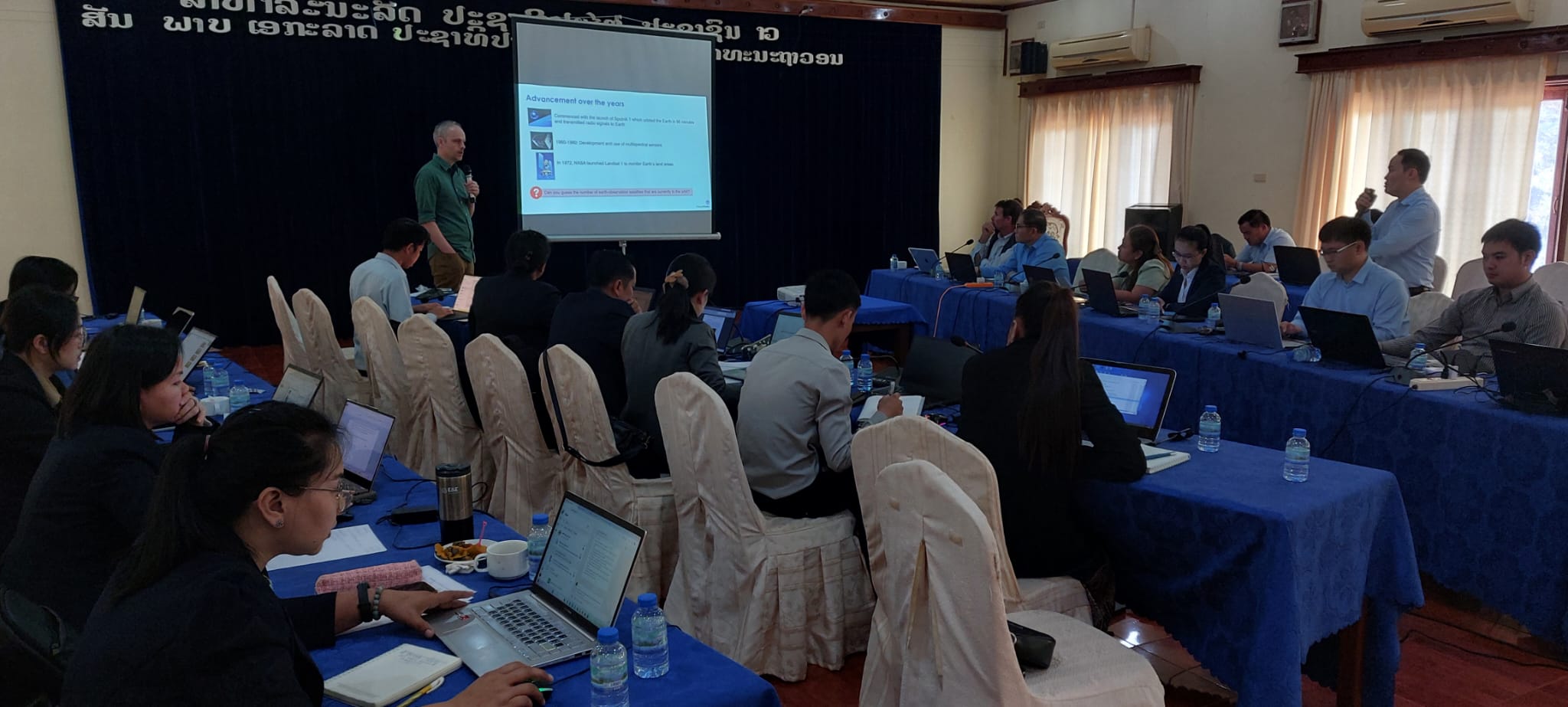
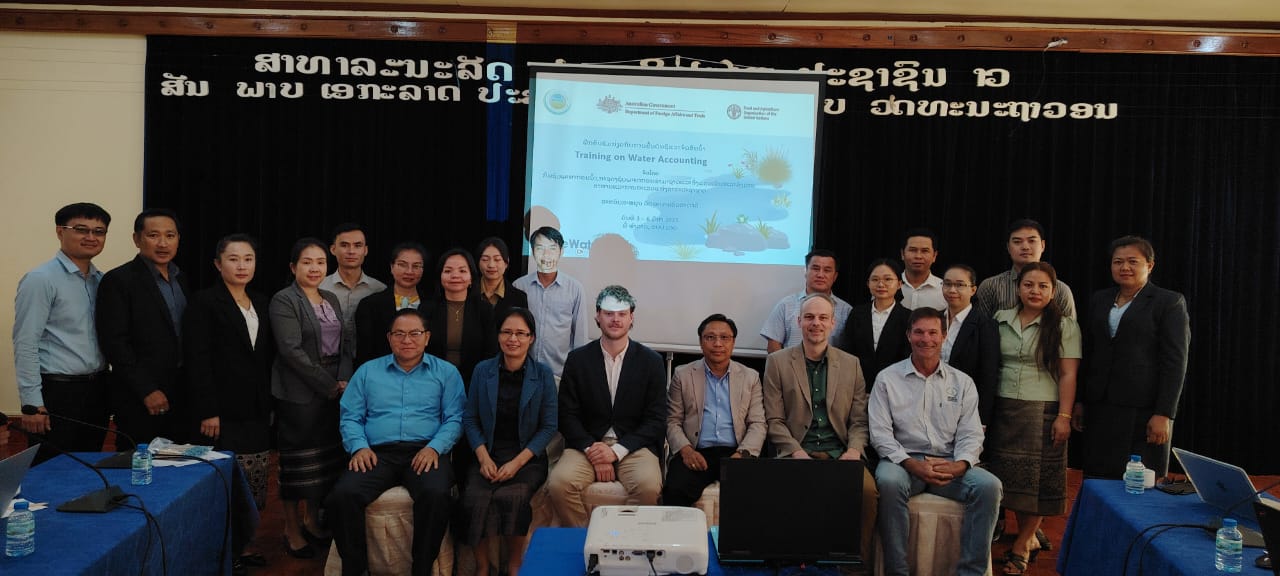
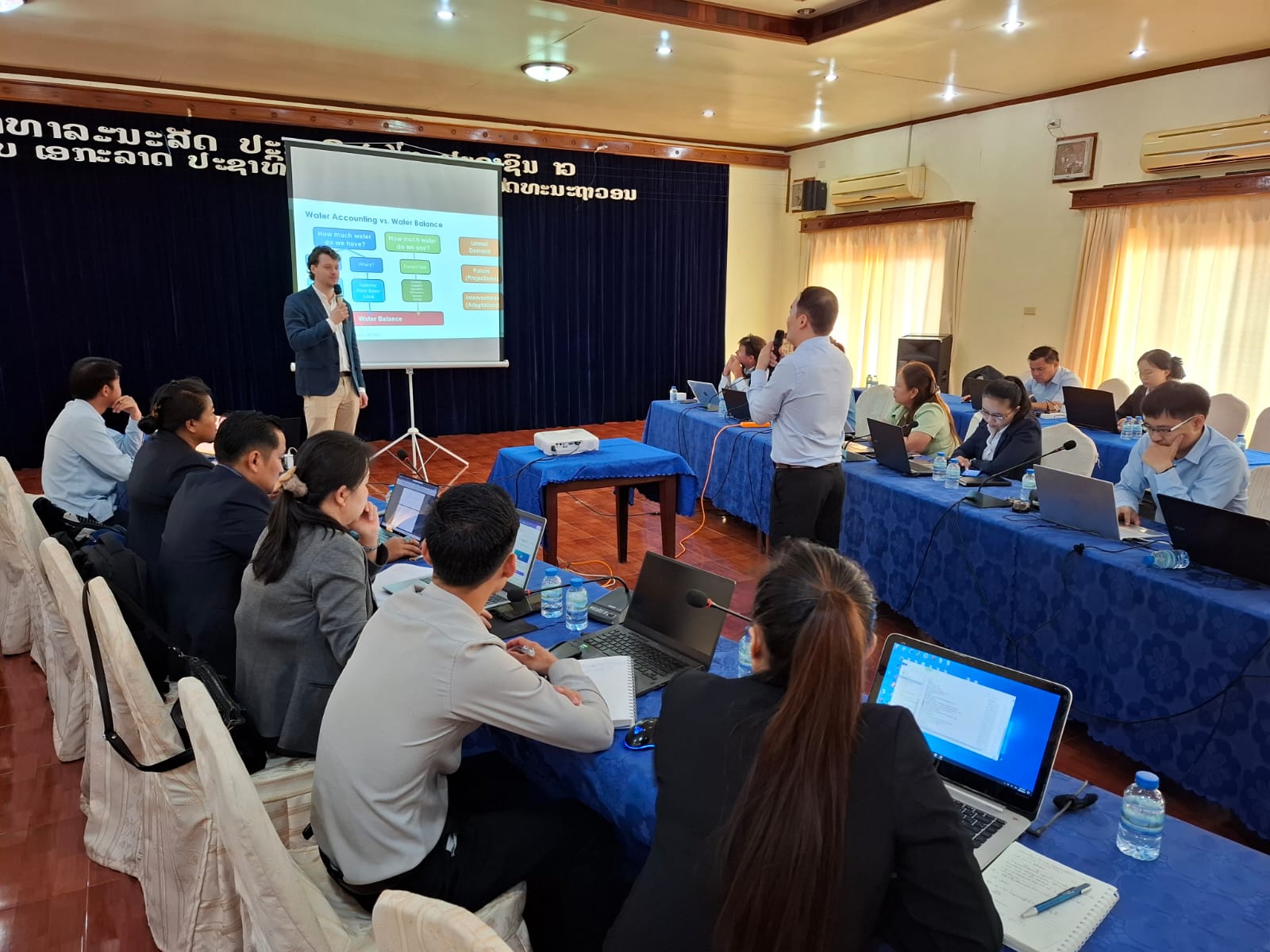
In early March 2025, the second phase of Water Accounting training under FAO’s Water Scarcity Program was held. The training focused on collecting and analyzing spatial data to build and simulate a water account. Participants from various governmental institutions worked with open-source datasets to compute seasonal water balances and assessed water availability and interventions in the Xe Champhone pilot basin.

A key component of the training was the use of Google Earth Engine (GEE), where participants learned how to extract and process remotely sensed precipitation, evapotranspiration, and land use data. These datasets were used to calculate the water accounting components, including inflows, outflows, demands, and unmet demands. In the program’s second half, participants were introduced to the Water Evaluation and Planning (WEAP) model, which simulates water balance and supply-demand dynamics in river basins and irrigation systems. Using a tutorial model for the Xe Champhone River Basin in Savannakhet Province, participants explored how to build and adjust scenarios to assess the potential impacts of future projections and policy or management interventions on water availability, demands, and supply. These exercises support participants in making informed, data-driven decisions.

Participants were strongly motivated to apply water accounting in their daily work, and many expressed interest in institutional follow-up. While the training exercises focused on the Xe Champhone basin, participants recognized the potential for applying water accounting approaches more broadly. This momentum can serve as a foundation for scaling up water efforts across the Lao PDR.

Remote sensing lecture
Group picture
Water Accounting lecture

A consortium of international development finance institutions led by World bank and including Asian Development Bank (ADB) have signaled their intention to support the financing of the project. The climate risk management approach of the ADB aims to reduce risks resulting from climate change to investment projects by identifying climate change risks to project performance in the early stages of project development and incorporating adaptation measures in the design.

For this project FutureWater undertakes work to analyze climate change risk faced by Rogun HPP and the interaction between climate change, climate-responsive HPP operation, and downstream water resource demand as a 2nd phase following initial due diligence of ADB on available project documentation. The detailed tasks entail:

  • Analyze downscaled CMIP6 General Circulation Model (GCM) to understand projected changes in precipitation and heat trends across climate change scenarios in the Rogun dam catchment area. This includes assessment of indicators for likelihood of heatwave and extreme precipitation events.
  • Undertake an estimate of the Probable Maximum Flood level in the Rogun dam catchment through event-based simulation modelling factoring in changes to projections for extreme precipitation events and changing hydrological processes due to climate change.
  • Estimate the likelihood of annual discharge change based on climate change projections to understand the likelihood of Rogun HPP project economics being negatively affected by declining capacity factor driven by climate change impacts on hydrology.
  • Conduct a first order analysis of present and future glacial lake outburst flood risk based on review of studies from reputable sources.

With the results of this analysis, ADB can update earlier climate risk studies and guide investment decisions.


With the highest rate of urbanization in South Asia and as one of the most vulnerable countries to climate change, Pakistan faces a range of complex challenges, including more frequent and intense flooding, declining economic productivity, and deteriorating public services. Growing dependence on groundwater, coupled with insufficient surface water recharge, is leading to severe localized groundwater depletion.

With support from the Asian Development Bank, the Government of Pakistan aims to upgrade and expand water and sanitation infrastructure in the cities of Sargodha and DG Khan, both of which face significant climate change-related challenges that impact combined drainage and sewer networks. The project has three major outputs:

  1. improving climate-resilient urban infrastructure and services,
  2. enhancing institutional capacity, operational efficiency, and gender inclusiveness of service providers, and
  3. creating greater economic empowerment opportunities for women in the WASH sector.

To assess the exposure and vulnerabilities of project components to potential climate risks, FutureWater will utilize advanced downscaled Coupled Model Intercomparison Project Phase 6 (CMIP6) ensembles, along with relevant hazard data and local information, to conduct a detailed Climate Risk Assessment (CRA). The insights gained will enable the Asian Development Bank (ADB) to implement effective adaptation measures and ensure climate-resilient development.

To this end, FutureWater, in collaboration with unique land use GmbH and the Central Himalayan Rural Action Group, is conducting a training program on Springshed Management in four states, Uttarakhand, Himachal Pradesh, Madhya Pradesh, and Uttar Pradesh India. The program aims to equip the local stakeholders with practical tools and best practices for managing springshed and springs in the region. The key beneficiaries of these trainings are the forest departments of these four states under the Ministry of Environment, Forestry and Climate Change (MoEF&CC). Funded by GIZ India, these trainings will covers key topics, including:

  • Concepts of springs and springshed management protocols and best practices
  • Hydro-geological data collection during a field expedition
  • Springshed mapping
  • Connecting forest ecosystem services to water resources

For the first round of training the consortium will start training with the Uttarakhand Forest Department (UKFD) in Dehradun, India. This initiative aims to strengthen sustainable water management practices and safeguard these critical water sources for future generations.