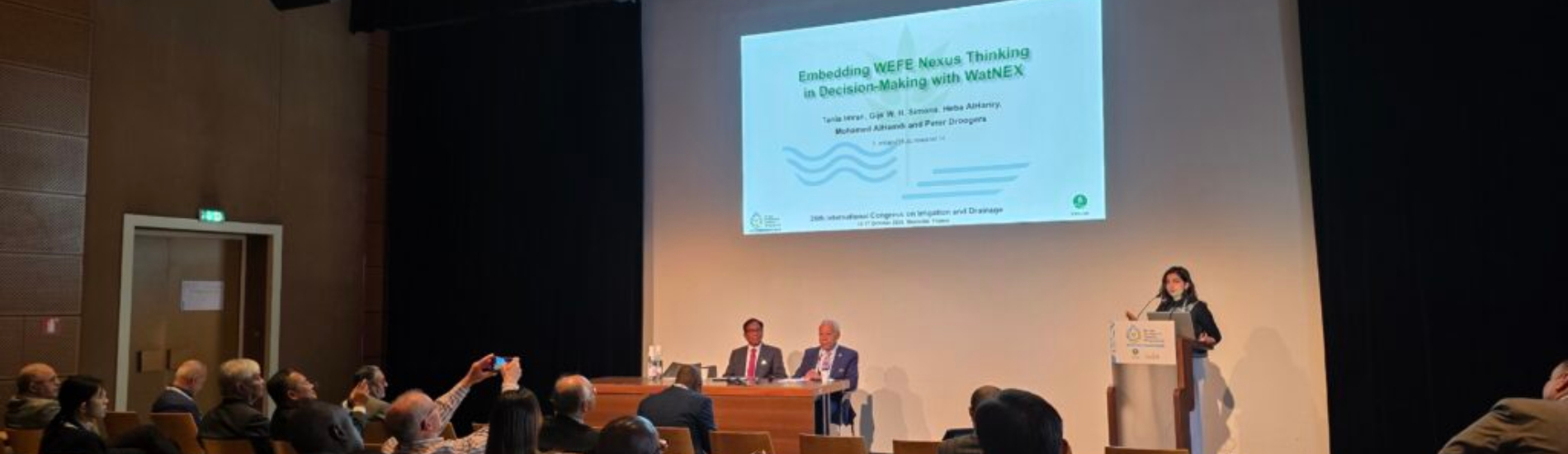
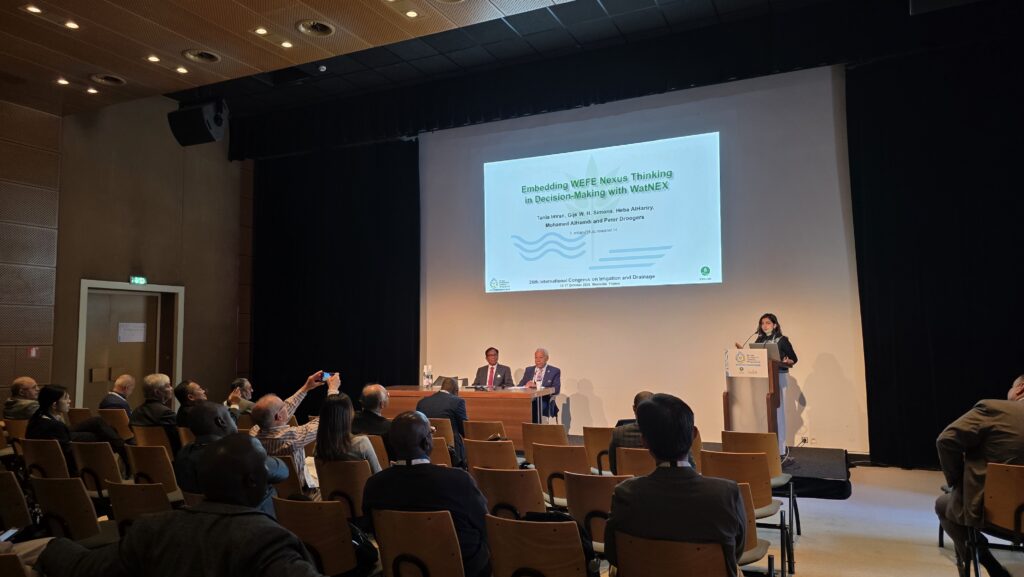
FutureWater brought WatNEX to the 26th ICID International Congress in Marseille, France (12–17 October 2026). On 13 October, the congress dedicated a full day to the international workshop “Implementation of the Water-Energy-Food (WEF) Nexus at different scales for Socio-Economic Development”. The workshop brought together more than 50 experts from across the globe working on the operationalization of the nexus.
Organized by ICID’s Working Group on Water-Food-Energy Nexus, the workshop was the right stage for a tool built to put the nexus into practice. Tania Imran, from FutureWater, presented insights from the paper “Embedding WEFE Nexus Thinking in Decision-Making with WatNEX”. It was written jointly with FAO’s Regional Office for the Near East and North Africa under FAO’s inter-Regional Technical Platform on Water Scarcity (iRTP-WS). The paper zooms in on two of the three WatNEX case studies (Tuul River Basin in Mongolia and Lower Medjerda Basin in Tunisia).
WatNEX leverages water accounting data to assess and balance resource use and demands across water, energy, food and ecosystems, over time and at multiple scales. Users define their study area by hydrological boundaries, administrative boundaries, or both. Within that area they can set up multiple “nexus units”, analyzing interactions locally while still seeing the bigger picture for the whole system.
The result? Decision-makers can quantify WEFE synergies and trade-offs under different scenarios, from future projections to management interventions. In Mongolia, for example, extra groundwater pumping cut unmet domestic water demand by 36%, but energy demand rose by 261%. A trade-off like this stays invisible in a water-only analysis.