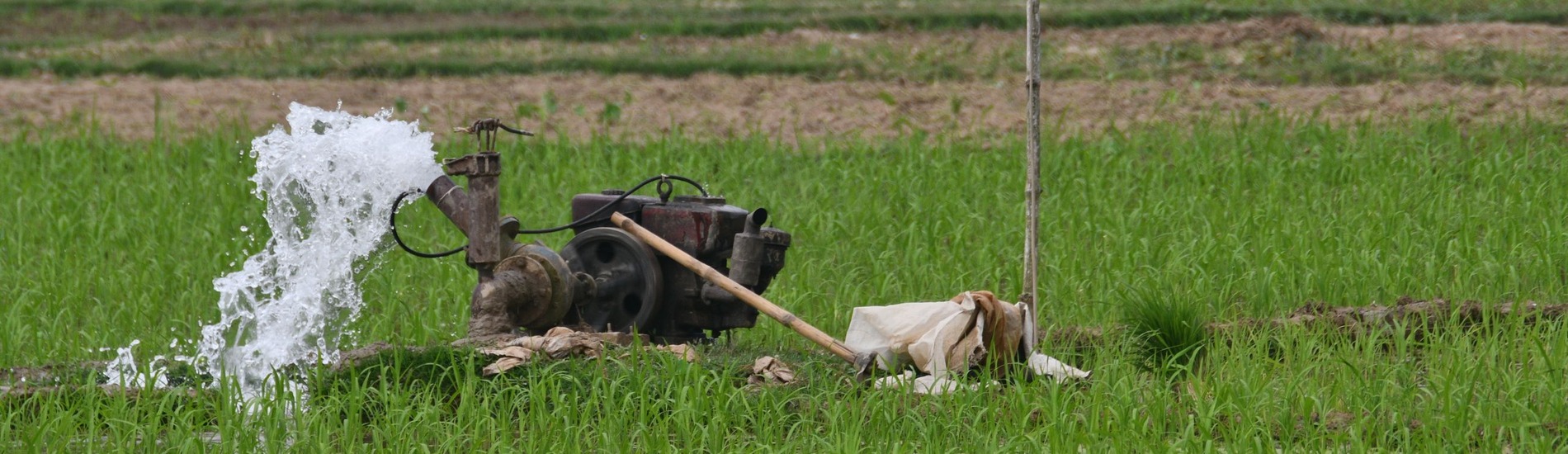
The Barind tract in north-western Bangladesh depends on groundwater for dry season irrigation, and both rainfall and temperature extremes are shifting. The Asian Development Bank (ADB) is preparing two investments in the region: the Barind Area Resilient and Innovative Development (BARIND) Project and the North-Western Area Sustainable Agri-food Corridor (NASA). FutureWater supports the design of both as climate change and disaster risk management specialist, carrying out a climate risk and adaptation assessment, quantifying expected greenhouse gas emissions, estimating climate adaptation and mitigation finance, and assessing alignment with the Paris Agreement. The analysis feeds the feasibility studies and the climate change assessment that accompanies ADB's report and recommendation of the President.
Agriculture in north-western Bangladesh runs on groundwater. The Barind tract is the driest part of the country, dry season cropping depends on pumping, and the water table has been falling while heat and rainfall extremes shift. An investment that expands irrigation or agri-food production in the region therefore has to be designed against a changing hydroclimate rather than against the historical record.
The Asian Development Bank (ADB) is preparing two such investments, the Barind Area Resilient and Innovative Development Project and the North-Western Area Sustainable Agri-food Corridor. Under the facility that strengthens ADB’s capacity to design climate resilience projects, FutureWater provides the climate change and disaster risk management specialist for both, working alongside the project teams, sector specialists and feasibility consultants so that the analysis enters the design rather than following it.
The assessment starts from ADB’s climate and disaster risk screening and sets its scope and level of detail from there. Project components are mapped to their locations and design lives, hazard occurrence and exposure are analysed over a 30 year baseline, and future hazard intensity and frequency are derived from a CMIP6 ensemble under a high emissions scenario, read at an agreed design percentile rather than at the ensemble mean. Sensitivity and adaptive capacity give a vulnerability level per component, and the two combine into a climate risk that can carry a cost benefit or multi criteria comparison of adaptation options.
Adaptation and disaster risk management options are then identified across hard and soft measures and tested for technical, institutional and socioeconomic feasibility. In parallel the work quantifies expected greenhouse gas emissions and low carbon options, estimates adaptation and mitigation finance under the joint multilateral development bank methodology, and prepares the climate change assessment and Paris Agreement alignment material for ADB. Capacity building workshops for the executing agencies are part of the assignment.