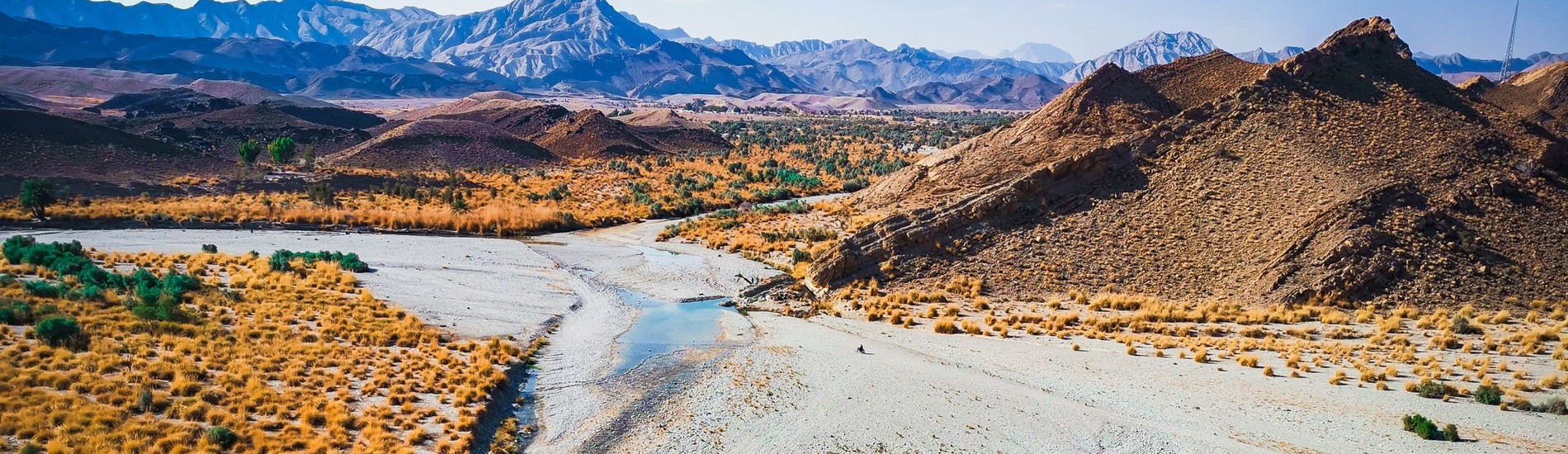
NOAA and IRI have issued an El Niño advisory, with the Pacific signal expected to strengthen into a moderate to strong event peaking in autumn 2026. For Yemen and Djibouti this points to two hazards in sequence: a weaker summer monsoon from June to September, which is the main rainfed and spate irrigation season, followed by heavier and more erratic rainfall from October to February. FutureWater, in a joint venture led by Acacia Water, is preparing a rapid seasonal drought and flood outlook for the World Bank. The outlook combines historical El Niño evidence with a machine learning model of large scale climate drivers, and expresses the result in impact categories per climatic zone, to support decisions on anticipatory action.
Yemen and Djibouti depend on two short rainfall seasons. The summer monsoon from June to September carries most of the rain that feeds rainfed farming and spate irrigation, while October to February brings shorter and more erratic storms that can turn wadis into flash floods. El Niño, the warm phase of the El Niño Southern Oscillation, tends to weaken the first season and intensify the second, so a single event can bring drought and flooding in sequence.
The World Bank needs to know whether the current signal points to elevated drought and flash flood risk in the coming season, early enough for anticipatory action to be discussed with government and development partners. FutureWater delivers the assessment as part of a joint venture led by Acacia Water, producing a rapid seasonal outlook report for each country within six weeks.
The outlook is built in three steps. Historical El Niño events are reviewed against satellite rainfall, vegetation condition, disaster records and humanitarian reporting, to establish which seasons and regions have been most sensitive. A Random Forest model then relates large scale drivers, including the Niño 3.4 index, the Indian Ocean Dipole and antecedent rainfall, to local rainfall and drought anomalies, validated by leave one year out cross validation and reported together with its skill. Forecasts are produced for three climatic zones rather than governorates, because seasonal anomalies follow climate rather than administrative boundaries.
Model output and historical analogues are blended into impact categories anchored in the observed local distribution, so the outlook stays usable where forecast skill is limited. Each country report sets out the seasonal outlook and its implications for anticipatory action, with appendices on drought vegetation response and on El Niño associated flash floods, and a short slide deck for discussion with the World Bank and its partners.