Across scientific disciplines, researchers face increasingly similar challenges: managing large volumes of data, processing complex images, automating repetitive tasks, and ensuring that results are reliable and reproducible. Advances in artificial intelligence, data analytics, and workflow automation offer new opportunities to address these challenges, helping researchers move beyond isolated tasks towards more integrated and efficient ways of working.
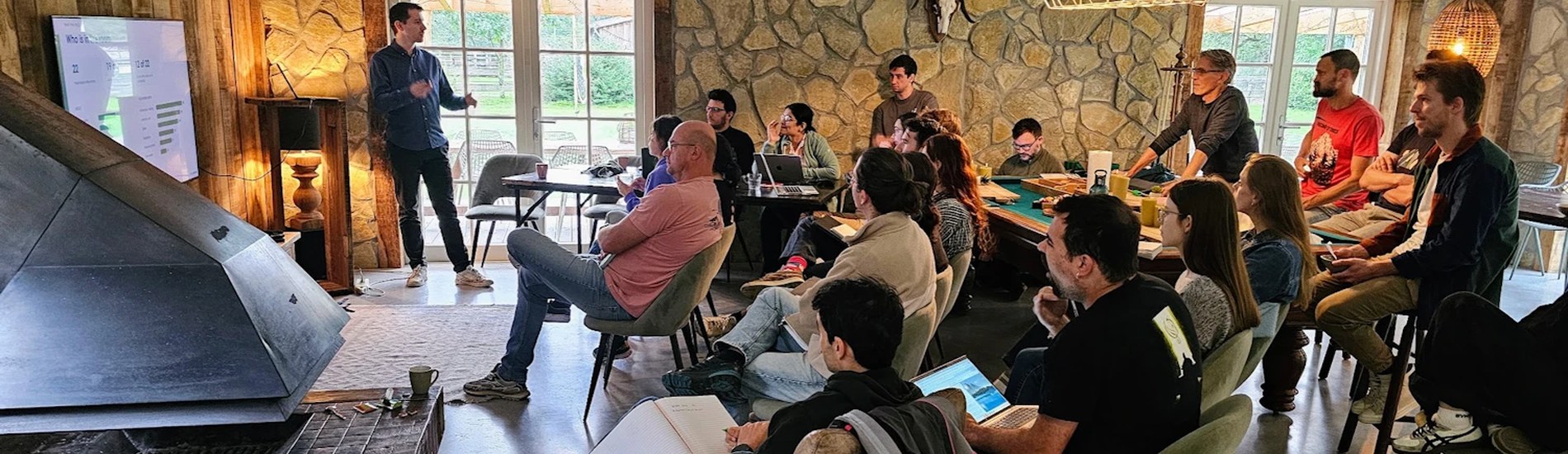
On 17 September, FutureWater brought its expertise in quantitative analysis, data processing, and digital innovation to a tailored half-day workshop for the Kops research group at the Hubrecht Institute in the Netherlands. Held during the group’s retreat, the workshop explored how approaches developed in water and environmental research can be transferred to other scientific disciplines, supporting more effective use of data, analytical methods, and emerging technologies.
The workshop combined practical demonstrations with hands-on exercises built around participants’ own research challenges. One researcher developed a plugin to accelerate scientific image processing and analysis, while the group’s microscope coordinator created a structured troubleshooting workflow to help colleagues identify and resolve common technical issues independently.Other participants explored applications ranging from scientific literature screening and source verification to manuscript preparation aligned with journal requirements, and the transformation of laboratory protocols into structured project plans.
Beyond these individual applications, the workshop addressed broader opportunities for integrating AI and advanced analytical tools into scientific practice. Topics included organising research data, developing reusable and reproducible workflows, connecting tools to existing research environments, improving scientific communication, and incorporating quality control and human oversight into automated processes. The emphasis was on building practical capabilities that researchers can adapt to their own needs, rather than relying on a single tool or platform.
Feedback was encouraging: all 19 participants who completed the evaluation indicated that they were likely to make use of the AI tool introduced during the workshop in their work over the following month, with 17 reporting that they were very likely to do so.
Beyond the adoption of any individual technology, the broader ambition is to empower research teams to integrate advanced analytics, intelligent automation, and reproducible workflows into everyday scientific practice, accelerating discovery, strengthening research quality, and opening new opportunities for innovation and collaboration across disciplines.
Read more about FutureWater’s tailored training for the Hubrecht Institute.